Composable Data Architectures: From Platform Modernisation to Enterprise Readiness
Modern platforms do not automatically create enterprise-ready data. This perspective explores how composable data architecture helps organisations move from fragmented data activity to reusable, governed and adaptable data foundations.
Why composable data architecture matters now
Most organisations are not short of data activity. They have data platforms, dashboards, integration pipelines, cloud programs, governance forums, reporting teams and now AI initiatives.
The problem is that these activities often evolve separately.
A cloud data platform may exist, but the organisation still lacks common definitions. A reporting layer may be modern, but metrics still disagree. A data catalogue may be implemented, but ownership and quality expectations are unclear. AI pilots may begin, but the information assets feeding those models are not yet well understood or governed.
This is where composable data architecture becomes relevant — not as a new buzzword, and not as another platform label, but as a response to a familiar enterprise problem: data change is still too slow, too duplicated, too fragile and too dependent on individual knowledge.
Composable data architecture is about designing the data landscape so trusted data capabilities can be reused, extended and adapted as the organisation changes.
What composable data architecture really means
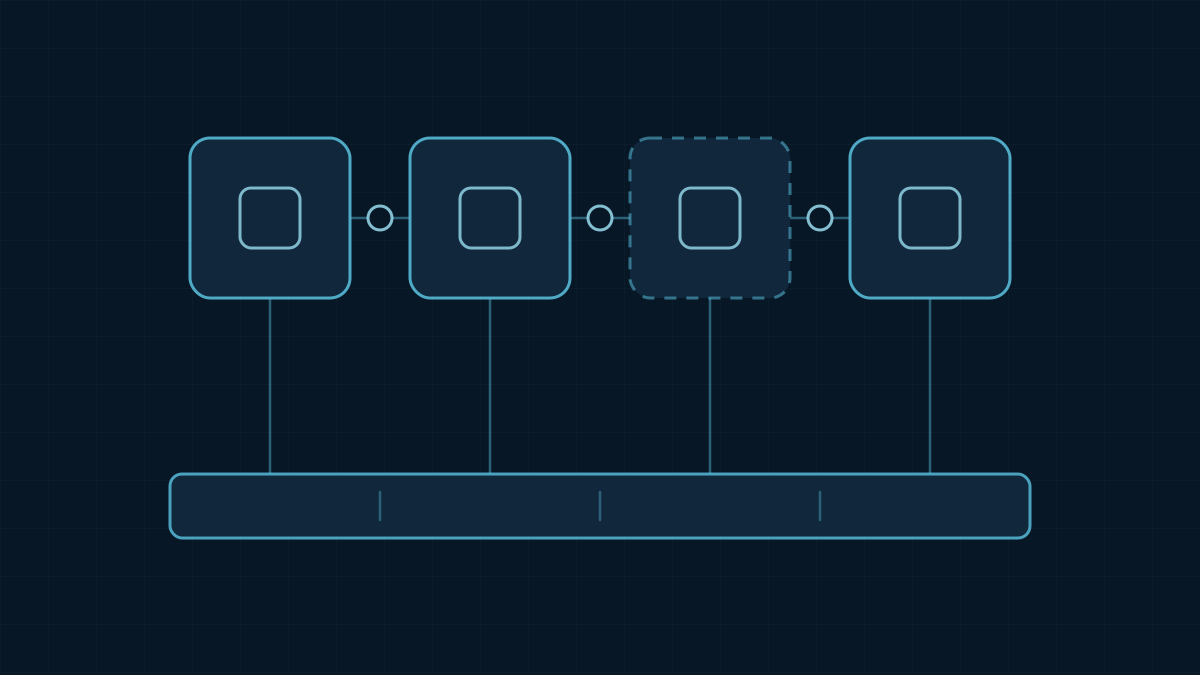
Composable data architecture is not a single product, framework or vendor pattern. It is an architectural approach in which data capabilities are designed as modular, reusable and governable building blocks.
These building blocks may include:
- Data domains
- Information assets
- Canonical and logical data models
- Reusable data products
- Semantic models
- Metadata and lineage
- Integration and engineering patterns
- Data quality controls
- Governance rules
- Access and consumption patterns
The intent is simple: data should not be rebuilt from scratch every time a program, report, platform or AI use case needs it. Composable architecture asks a consistent set of questions:
- Can this data capability be reused?
- Is its meaning clear?
- Is ownership defined?
- Are quality expectations known?
- Is lineage visible?
- Can consumers safely use it?
- Can it adapt when the business changes?
That is why composability is not only a technology concern. It sits at the intersection of strategy, architecture, data management, governance and delivery.
What organisations are already doing
Most organisations are already doing parts of composable architecture, even if they do not use that term. They may already have:
- Cloud data platforms
- Lakehouse or warehouse modernisation programs
- Self-service reporting and visualisation
- Data catalogues
- Data governance forums
- Data quality rules
- Master and reference data initiatives
- Domain-aligned reporting datasets
- Curated analytics layers
- AI and machine learning pilots
- Integration standards
- Metadata or lineage tooling
So the foundations are not always missing. Often, they are implicit. They exist inside project documents, transformation logic, report definitions, spreadsheets, data marts, analyst knowledge, source-system rules, architecture diagrams and business memory.
The issue is that implicit foundations are hard to scale.
- If a definition exists only in a report, it cannot easily become an enterprise standard.
- If data quality rules are buried in pipelines, they are hard to govern.
- If ownership depends on knowing who to ask, it is not operationally reliable.
- If data products are created by projects but never managed through a lifecycle, they quickly become another form of technical debt.
Composable architecture is about making these foundations explicit, connected and reusable.
Where platform modernisation falls short
Platform modernisation is necessary, but it is not sufficient.
A modern cloud platform can improve scalability, performance, automation and access. But it does not automatically solve enterprise data problems.
Organisations can move from an on-premise data warehouse to a cloud lakehouse and still carry forward the same issues:
- Inconsistent definitions
- Duplicated transformations
- Unclear ownership
- Report-specific business logic
- Weak metadata
- Limited lineage
- Ungoverned extracts
- Poor data quality accountability
- Fragmented semantic layers
- Limited reuse across programs
This is why many organisations feel disappointed after major platform investment. The platform is modern, but the data operating model remains immature.
Industry analysis of next-generation data products makes a similar point: organisations seeking successful data products often need to revise both data architecture and governance, not simply build new datasets on modern technology.
That distinction matters. A platform can host reusable data capabilities. It cannot, by itself, define what should be reusable, who owns it, what quality means, how it should be consumed, or how it changes over time.
Reassessing data strategy and enterprise architecture
Composable data architecture starts with a reassessment of the organisation's fundamental data strategy and architecture.
The key question is not “which platform should we use?” The more useful questions are:
- What information assets are critical to the organisation?
- Which data domains matter most?
- Which business capabilities depend on trusted data?
- Where is reporting or operational decision-making most fragile?
- Which data is repeatedly rebuilt across teams?
- Which definitions create the most confusion?
- Where are AI and analytics ambitions constrained by weak foundations?
- Which data needs stronger lifecycle, records, privacy or security controls?
- What should be governed centrally, and what should be owned by domains?
This requires strategy and architecture to work together.
Strategy sets direction: what matters, why it matters, and where investment should focus. Architecture provides structure: domains, models, patterns, platforms, information assets, semantic layers and reusable data products. Governance provides oversight and control: ownership, standards, stewardship, quality rules, lifecycle controls, metadata and decision rights.
If any of these evolve in isolation, composability weakens. A strategy without architecture becomes aspiration. Architecture without strategy becomes technical design without priority. Governance without architecture becomes policy without adoption.
What makes data reliable, reusable and ready for change
For data to become composable, it needs more than availability. It must be reliable, reusable and ready for change. That depends on several practical foundations.
Clear data domains
Data domains help organise data around the business, not just around systems. They create a more stable way to discuss ownership, reuse, quality, integration and consumption.
Information assets
Organisations need to know which information assets matter most — the data used for reporting, operations, compliance, records, analytics, AI and executive decision-making.
Shared models and definitions
Conceptual, logical, canonical and semantic models help create shared meaning. They reduce dependency on source-system structures and help teams speak a common language.
Ownership and stewardship
Reusable data needs clear accountability. Someone must own the meaning, quality expectations, lifecycle and appropriate use of important data assets.
Metadata and lineage
Metadata and lineage make data understandable and traceable. Without them, consumers may access data but still not know whether they can trust it.
Quality and control points
Data quality needs to be visible, measured and owned. Controls should be embedded into pipelines, reporting layers, data products and governance processes.
Consumption patterns
Composable data must be easy and safe to consume. That means defining how data is accessed, what restrictions apply, what level of quality is expected, and how consumers request changes or raise issues.
Lifecycle management
Data products and information assets need lifecycle thinking. They should be created, maintained, monitored, improved and retired intentionally.
Industry technology commentary has reinforced this through data product thinking, emphasising consumer-centric design to increase adoption and value. This matters because composability depends not only on publishing data, but on making data usable and trusted by the people and systems that consume it.
Our perspective: enterprise readiness is the real goal
Our view is that composable data architecture should not be treated as a destination in itself. The real goal is enterprise readiness.
Enterprise readiness means the organisation can respond to change without repeatedly rebuilding, reconciling and re-governing the same data. It means data foundations are strong enough to support:
- New systems
- New reporting needs
- New regulatory expectations
- New integration patterns
- New analytics and AI use cases
- New business structures
- New operating models
This is where composability becomes practical. The point is not to label everything a data product or adopt every new architecture pattern. The point is to make the data landscape easier to understand, govern, reuse and adapt.
Many organisations already have parts of this foundation. The opportunity now is to connect them — moving from platform modernisation to enterprise readiness by making strategy, architecture and governance work as one.
- Enterprise Data Architecture
- Data Strategy
- Data Governance
- Data Products
- AI Readiness
- Information Architecture